Some transactions may be missing from the records and others may not have been recorded properly. These transactions must be dealt with properly before preparing financial statements. In February, you record the money you’ll need how to increase your cen exam score to pay the contractor as an accrued expense, debiting your labor expenses account. When you generate revenue in one accounting period, but don’t recognize it until a later period, you need to make an accrued revenue adjustment.
- Payments for goods to be delivered in the future or services to be performed is considered unearned revenue.
- For example, if an adjustment entry is made to defer revenue to a future accounting period, this will delay the recognition of revenue until the future period.
- To understand the impact of accrued vacation pay on financial management, explore this insightful article on managing vacation pay.
- Staying up-to-date prevents discrepancies and keeps your financial reporting accurate.
Recording Common Types of Adjusting Entries
You’re not going to get all of the value from the vehicle in the month that you buy it. It’s going to be used to generate revenue over an extended period of time (the asset’s useful life) — 8 years, say. The entry for insurance reflects six months’ expenses, which have been paid, but coverage of only one month could have been used by June end. For example, a company that has a fiscal year ending Dec. 31 takes out a loan from the bank on Dec. 1.
Adjusting Entries Examples
For the past 52 years, Harold Averkamp (CPA, MBA) hasworked as an accounting supervisor, manager, consultant, university instructor, and innovator in teaching accounting online. When you join PRO Plus, you will receive lifetime access to all of our premium materials, as well as 12 different Certificates of Achievement. For the past 52 years, Harold Averkamp (CPA, MBA) has worked as an accounting supervisor, manager, consultant, university instructor, and innovator in teaching accounting online. Someone on our team will connect you with a financial professional in our network holding the correct designation and expertise. Our writing and editorial staff are a team of experts holding advanced financial designations and have written for most major financial media publications. Our work has been directly cited by organizations including Entrepreneur, Business Insider, Investopedia, Forbes, CNBC, and many others.
Get in Touch With a Financial Advisor
The $600 isadded to the previous $9,500 balance in the account to get a newfinal credit balance of $10,100. With an adjusting entry, the amount of change occurring duringthe period is recorded. Similarly for unearned revenues, the companywould record how much of the revenue was earned during theperiod. Adjusting entries affect financial statements by ensuring that they accurately reflect a company’s financial position.
What Are the Types of Adjusting Journal Entries?
The accrued interest payable account will increase the company’s liability because interest expense was incurred but remain unpaid, and an equal amount will increase the expenses of the income statement. In the journal entry, Salaries Expense has a debit of $1,500.This is posted to the Salaries Expense T-account on the debit side(left side). You will notice there is already a debit balance inthis account from the January 20 employee salary expense. The$1,500 debit is added to the $3,600 debit to get a final balance of$5,100 (debit). Salaries Payable has a credit balance of $1,500.This is posted to the Salaries Payable T-account on the credit side(right side). Accounting software can be used to simplify the process of recording adjustment entries.

The adjusting entry will debit interest expense and credit interest payable for the amount of interest from Dec. 1 to Dec. 31. Recording transactions in your accounting software isn’t always enough to keep your records accurate. If you use accrual accounting, your accountant must also enter adjusting journal entries to keep your books in compliance. By recording these entries before you generate financial reports, you’ll get a better understanding of your actual revenue, expenses, and financial position. Adjusting entries are accounting journal entries that convert a company’s accounting records to the accrual basis of accounting.
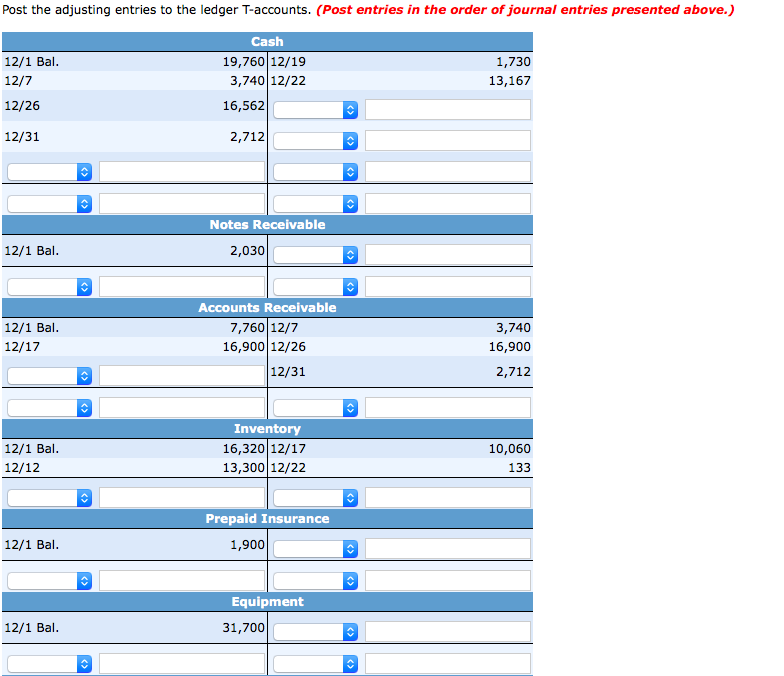
An accrued expense, for example, reflects a bill you’ve received but not yet paid. Accrued revenue, on the other hand, reflects invoices you’ve sent to customers for which you’re still waiting on payment. The cash hasn’t hit your account yet, so there is no ledger entry for that revenue. But from an accounting perspective — assuming your business uses the accrual basis rather than the cash basis — that revenue has been earned. They can also be used to correct mistakes made in the previous accounting period, though its not what adjusting entries are specifically designed for. Once you have journalized all of your adjusting entries, thenext step is posting the entries to your ledger.
This ensures your financial statements provide a true picture of your company’s obligations. For help with accurate accrual calculations, consider exploring accrual software solutions. Accrued vacation time—the time off your employees have earned but haven’t yet used—represents a real financial obligation for your business. It’s more than just a perk; it’s a liability that needs to be accurately reflected in your financial statements. From calculating accrual rates to understanding the nuances of different vacation policies, managing accrued vacation can feel complex.
This liability is recorded on the balance sheet, reflecting the company’s obligation to pay employees for their earned time off, as explained in this resource. Accurately calculating and recording this liability is essential for proper financial reporting. Consider exploring FinOptimal’s managed accounting services for assistance with these calculations and ensuring accurate financial statements. It ensures your financial statements (specifically, your balance sheet and income statement) accurately reflect your company’s liabilities and expenses. This is crucial for informed financial decision-making, securing loans, and attracting investors.
The number and variety of adjustments needed at the end of the accounting period differ depending on the size and nature of the business. The updating/correcting process is performed through journal entries that are made at the end of an accounting year. Before exploring adjusting entries in greater depth, let’s first consider accounting adjustments, why we need adjustments, and what their effects are.
Depreciation technically falls under the estimates umbrella, but since it’s so common in financial accounting, it’s worth discussing it specifically. Say, for example, that your company is a web design agency undertaking a large project that’s expected to take six months to complete. The client pays 20% up front, with the remainder being due on completion.
Leave a Reply